Easy to Moderate
Hoya Krimson Queen
Scientific Name
Hoya carnosa 'Krimson Queen'
Family
Apocynaceae
Native Region
Eastern Asia and Australia
Growth Rate
Slow to moderate
Origin + Story
Hoya carnosa is native to a wide range across Eastern Asia and Australia, growing as an epiphytic vine in subtropical and tropical forests. It climbs tree trunks and branches using adventitious roots, reaching for light in the forest canopy. The species has been cultivated as a houseplant since at least the early 1800s, making it one of the oldest tropical plants in Western indoor cultivation. The genus is named after Thomas Hoy, an 18th-century English botanist and head gardener to the Duke of Northumberland.
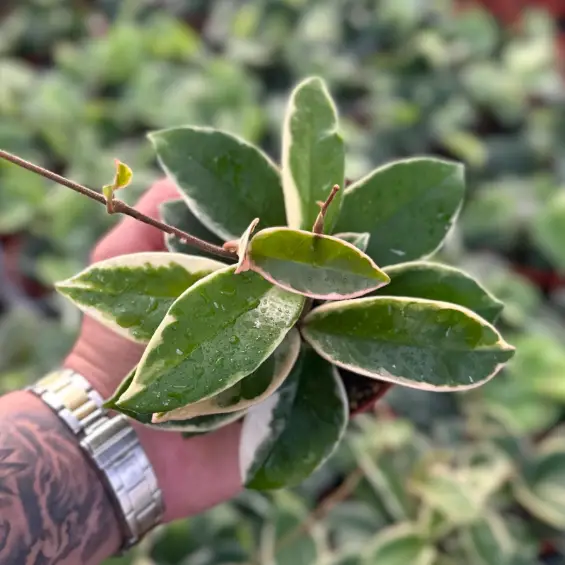
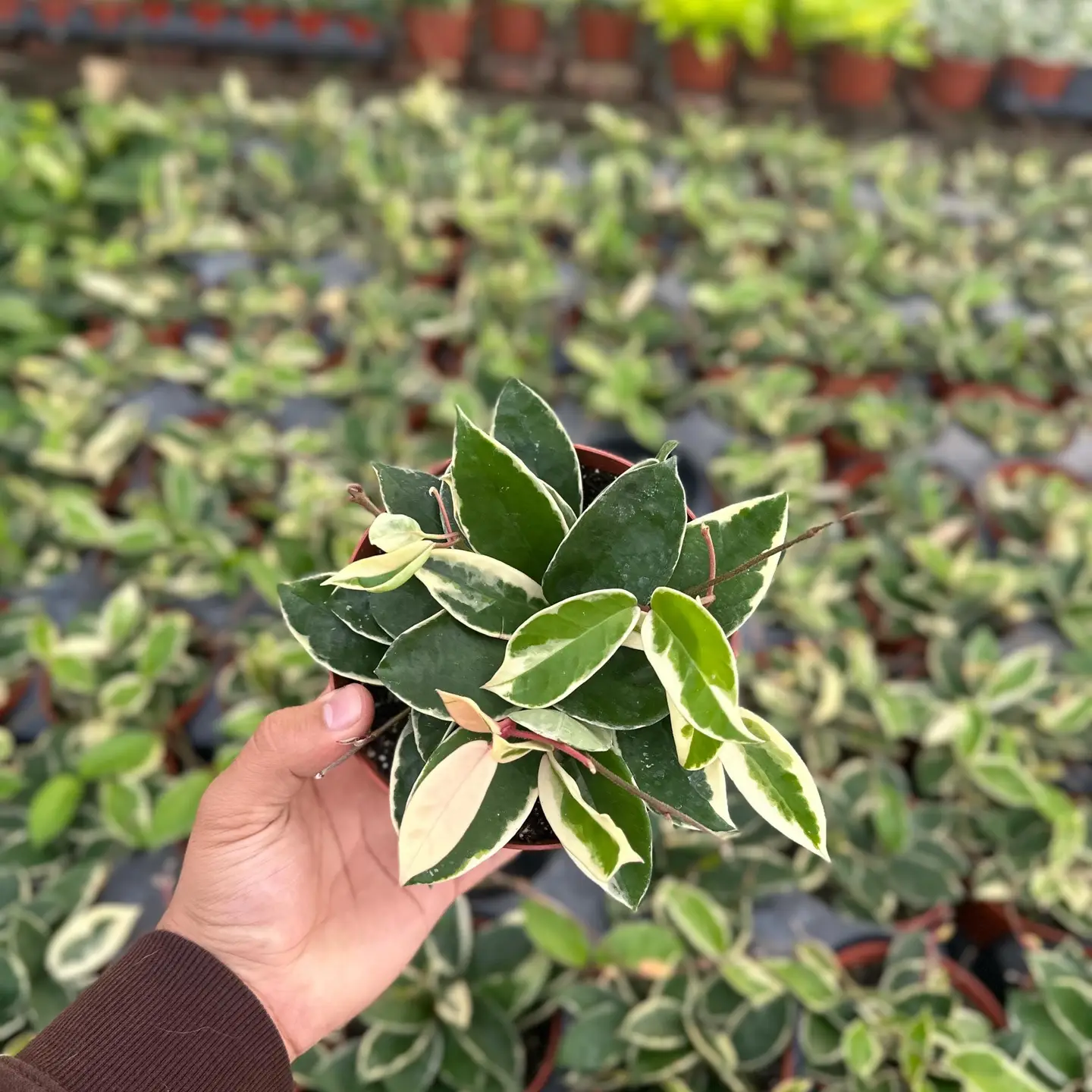
The 'Krimson Queen' cultivar (also sold as 'Tricolor') is a variegated sport of Hoya carnosa with creamy white to pink margins on waxy, oval leaves. The center of each leaf is green, providing the chlorophyll the plant needs, while the outer edges display a gradient from white to soft pink. The pink coloring is most vivid on new growth and on leaves that receive good light, as the pigment develops in response to light exposure. In lower light, the margins tend to stay white without the pink flush.
Krimson Queen is often confused with Hoya 'Krimson Princess,' another Hoya carnosa variegated cultivar. The distinction is straightforward: Krimson Queen has variegation on the leaf margins (edges are white/pink, center is green). Krimson Princess has variegation in the leaf center (center is cream/pink, edges are green). They are different cultivars with an inverted variegation pattern.
Like all Hoya carnosa varieties, Krimson Queen is capable of producing clusters of small, star-shaped, waxy flowers called umbels. The flowers are pale pink to white with a red center, sweetly fragrant especially in the evening. Flowering requires maturity, a period of cooler temperatures or reduced watering to trigger bud set, and patience. Many growers keep hoyas for years before seeing their first bloom, but the flowers are considered worth the wait.
Care guide
Light: Bright indirect. Some direct morning sun encouraged.
Water: When top 2 inches of soil are dry. Semi-succulent; err dry.
Humidity: Appreciates 40-60%. Tolerates average conditions.
Temperature: 60-80°F. Avoid cold drafts and temps below 50°F.
Soil: Very well-draining: orchid bark, perlite, potting soil, or a hoya-specific mix.
Toxicity: Non-toxic to cats and dogs.
Growth Rate: Slow to moderate. Faster in strong light with consistent care.
Detailed care
Light
Bright indirect light is ideal, and Krimson Queen benefits from some direct morning sun (one to three hours from an east-facing window). Strong light serves two purposes: it maintains the variegation and it brings out the pink coloring on the leaf margins. In insufficient light, the plant will produce more green-dominant leaves to compensate, and the pink flush will not develop. Avoid harsh afternoon direct sun, which can burn the white/pink portions of the leaves.
Watering
Hoya carnosa is semi-succulent; the thick, waxy leaves store water. Allow the top two inches of soil to dry out between waterings, and in winter, let the soil dry even further. Overwatering is the primary killer of hoyas. When you water, water thoroughly and let excess drain completely.
A slight wrinkling of the leaves is a reliable thirst signal. When the thick leaves feel slightly soft or show faint wrinkles, the plant is ready for water. It will plump back up within a day of a good soak.
Soil
Hoyas need extremely well-draining soil that mimics the airy conditions their roots experience in the wild as epiphytes. A mix of orchid bark, perlite, and a small amount of potting soil works well. Many hoya growers use a near-soilless mix: two parts orchid bark, one part perlite, one part horticultural charcoal. The roots need air.
Humidity
Appreciates 40-60% humidity but is more tolerant of average home conditions than many aroids. Krimson Queen does not typically suffer dramatically in 30-40% humidity, though higher moisture encourages healthier growth and reduces occasional browning on the variegated leaf edges.
Feeding + Fertilizing
Feed monthly during spring and summer with a balanced liquid fertilizer diluted to half strength. Some hoya growers switch to a phosphorus-heavy fertilizer in late summer to early fall to encourage flower bud formation. Stop feeding in winter. Hoyas are not heavy feeders.
Repotting
Hoyas prefer to be slightly rootbound and often bloom more readily when their roots are snug in the pot. Repot only when severely rootbound or when the soil has broken down, typically every two to three years. Go up only one pot size. Terracotta works well for breathability.
Blooming
The main triggers are maturity (at least two to three years of growth, often more), strong light, a period of slightly cooler temperatures (around 55-60°F for a few weeks in fall or winter), and reduced watering during that cool period. When flower buds appear, they emerge on peduncles. Critically: never remove the peduncles after flowers fade. Hoyas rebloom from the same peduncles.
Propagation
Stem cuttings with at least two nodes, rooted in water, sphagnum moss, or perlite. Roots develop in two to four weeks. It can take one to two years for a cutting to develop into a substantial plant. Select cuttings with good variegation.
Krimson Queen vs. Krimson Princess
The rule is simple: Queen has color on the edges, Princess has color in the center. Krimson Queen leaves have a green center with white-to-pink margins. Krimson Princess leaves have green edges with a creamy, often pinkish center. Both are cultivars of Hoya carnosa with identical care requirements.
Common Issues
Yellowing leaves: Overwatering is the most likely cause. Let the soil dry out more. Check roots for rot.
Loss of pink coloring: Insufficient light. Move to a brighter spot with some morning sun.
Variegation reverting to all green: Also a light issue. Prune reverted growth and increase brightness.
Brown, crispy edges on white/pink sections: Low humidity, too much direct sun, or natural fragility of chlorophyll-free tissue.
No flowers after years of growth: Ensure strong light, consider a cool rest period in fall, reduce watering during that time, and do not remove old peduncles.
Leaf drop: Usually from cold drafts, sudden temperature changes, or severe overwatering.
Mealybugs: Hoyas are susceptible, especially at leaf axils and on new growth. Treat with isopropyl alcohol on a cotton swab.
Wrinkled leaves: The plant is thirsty. Give it a thorough soak and it will plump back up within a day.
Grows well with
Plants that share a trait: same family, similar care, or complementary aesthetics.