
Collector's Challenge
Pink Princess Philodendron
Scientific Name
Philodendron erubescens 'Pink Princess'
Family
Araceae
Native Region
Rainforests of Colombia
Growth Rate
Slow to moderate
Origin + Story
Chimeric, unpredictable, worth the patience.
Naming note. Not to be confused with 'Pink Congo,' which is a chemically induced pink coloration that fades to green within months. The Pink Princess has true, genetic chimeric variegation: naturally occurring, permanent (per leaf), and completely unique from plant to plant. If the pink looks too pink to be real, it probably is.
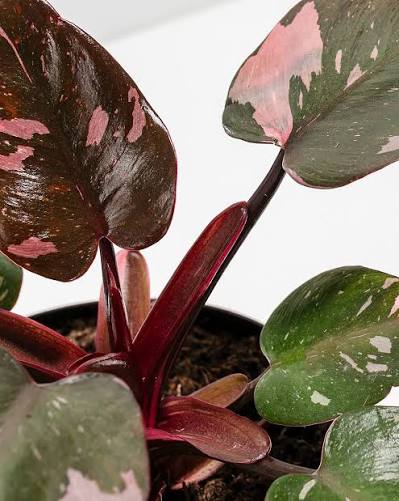
A cultivar of Philodendron erubescens, native to the rainforests of Colombia. The Pink Princess was selected and stabilized for its chimeric variegation, which produces sections of pink tissue alongside deep green and burgundy. Chimeric means the variegation is unstable at the genetic level and expresses differently in every new leaf.
Heart-shaped leaves in deep forest green splashed with brilliant pink, sometimes bubblegum, sometimes coral, sometimes half-and-half. Every leaf is a coin flip. Every plant has its own personality.
Grows well with moss poles, collector shelves, cream and clay tones, and anyone who understands that some plants are collaborations, not purchases.
Care guide
Light: Bright indirect light. Pink needs light to develop.
Water: When the top inch is dry.
Humidity: 50% and up.
Temperature: 65 to 80°F.
Soil: Chunky aroid mix.
Growth Rate: Slow to moderate.
Detailed care
Light
Bright, indirect. Insufficient light produces less pink or none at all. Too much direct sun burns the pink tissue.
Water
Top inch dry, then water thoroughly.
Humidity
50 to 70% ideal.
Soil
Chunky aroid mix.
Feeding
Balanced fertilizer monthly during the growing season, slightly diluted.
Pruning
If the plant reverts to all-green growth, prune back to a variegated node to redirect. If it pushes an all-pink leaf, it will not last (no chlorophyll), but enjoy it while it's there.
Propagation
Cuttings must include a node with visible variegation. All-green cuttings produce all-green plants.
Common Issues
Reverting to all-green: Common. Cut back to a variegated section.
All-pink leaves: Beautiful but unsustainable. They will eventually drop. Some collectors remove them to preserve plant energy; others let them have their moment.
Faded or absent pink: Not enough light.
Browning on pink sections: Sun damage or low humidity.
Yellowing: Overwatering.
Grows well with
Plants that share a trait: same family, similar care, or complementary aesthetics.